
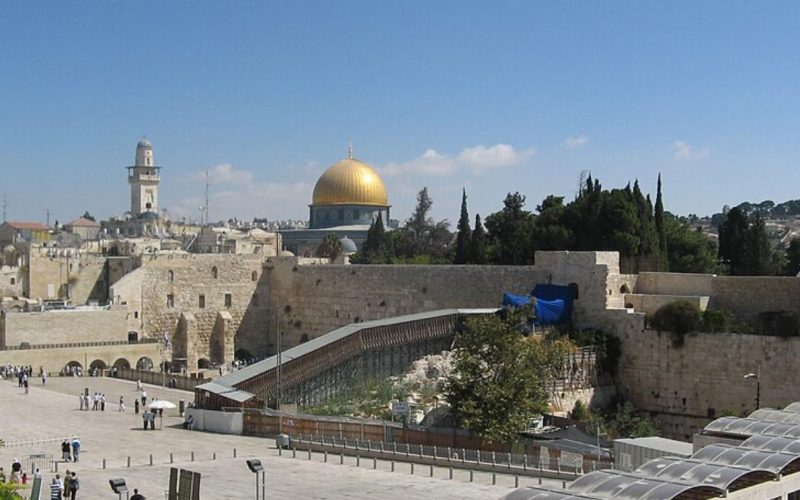
This is the second post in the Peoples of Israel series. Few countries anywhere have a story quite like this one: a people’s long connection to a specific piece of land, still visible today in its language, its calendar, and its cities. Understanding that story is part of understanding what you’re seeing on the ground in Israel.
A three-thousand-year connection
The Jewish connection to the Land of Israel stretches back more than three thousand years. According to the Hebrew Bible, King David established Jerusalem as the capital of his kingdom around 1000 BCE. Independent archaeological and epigraphic evidence also firmly establishes the existence of early Israelite and Judean societies in this land: inscriptions such as the Merneptah Stele, mentioning Israel in the late 13th century BCE, and the Tel Dan Stele, referring to the “House of David” in the 9th century BCE, are among the best-known examples.
Jewish communities continued to live in the land through many different periods, but modern Jewish immigration increased dramatically from 1882, with the First Aliyah and the beginnings of the modern Zionist settlement movement. For many Jews, this movement was understood not simply as immigration but as Aliyah — a return to their historical homeland.
A growing, diverse population
Around 24,000 Jews lived here in 1882. By the establishment of Israel in 1948, the Jewish population had grown to around 650,000, and today more than 7.7 million Jews live in Israel, according to Israel’s Central Bureau of Statistics (end of 2025).
Israeli Jewish society is itself a mosaic. It includes Ashkenazi, Sephardi and Mizrahi Jews, together with distinctive communities originating in Ethiopia, Yemen, Central Asia, India, the Caucasus, North Africa, Europe and many other regions. After 1948, Israel became a national home and refuge for Holocaust survivors and displaced European Jews, followed by large Jewish migrations from the Middle East and North Africa, the Soviet Union, Ethiopia and elsewhere.
A homeland written into the law
This idea of return is built into Israeli law. The Law of Return of 1950 gives every Jew the right to immigrate to Israel, with later amendments extending eligibility to certain close family members. Israel’s Basic Law defines the Land of Israel as the historical homeland of the Jewish people and states that the country shall remain open to Jewish immigration and the gathering of the exiles. For Jews arriving from dozens of different countries and cultures, Israel was therefore conceived not simply as a new destination, but as a return to a historical homeland and the creation of a shared national home.
Planning your visit
This layered history is exactly what makes travelling through Israel so rewarding — historic sites, modern cities and living communities from dozens of backgrounds all in the same short drive. My Your Private Tour sample itinerary is a good starting point if you’d like to see how a multi-day trip can bring this history to life.
See Also
8-Day Private Tour in Israel: follow Israel’s historic and modern story with a multi-day private tour built around your interests.